


Description
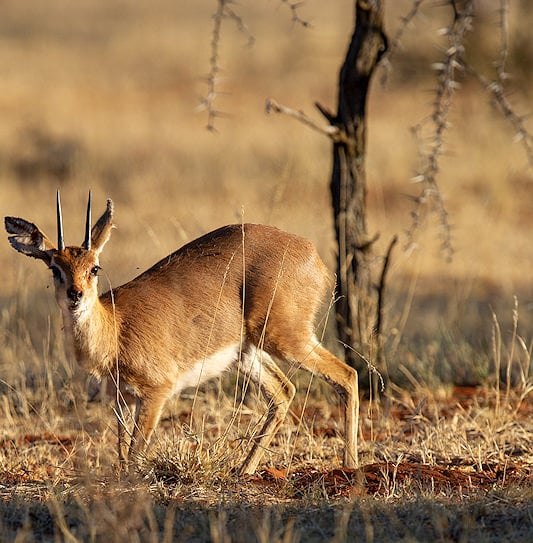
Steenbok are diminutive antelope with a pale red-orange coat, white underparts, and crisp white markings on the face, legs, and tail. Large, radar-like ears aid vigilance in open habitats, and only the male carries straight, spike-like horns. Typically solitary and alert, steenbok rely on stillness, sudden zigzags, and short sprints to evade detection and close threats on open ground.
Steenbok are shy little antelope and are often mistaken for impala lambs. They are found throughout Kruger National Park, although they are generally easier to spot and photograph in the grassland areas of the park, namely between Tshokwane and the Olifants River. They are generally found in pairs, so if you only see one animal, its partner may be resting or hiding somewhere nearby.
 - Mary-Anne Finlay - Tour Guide Since 2006 (THETA Registration No: GP 2432)
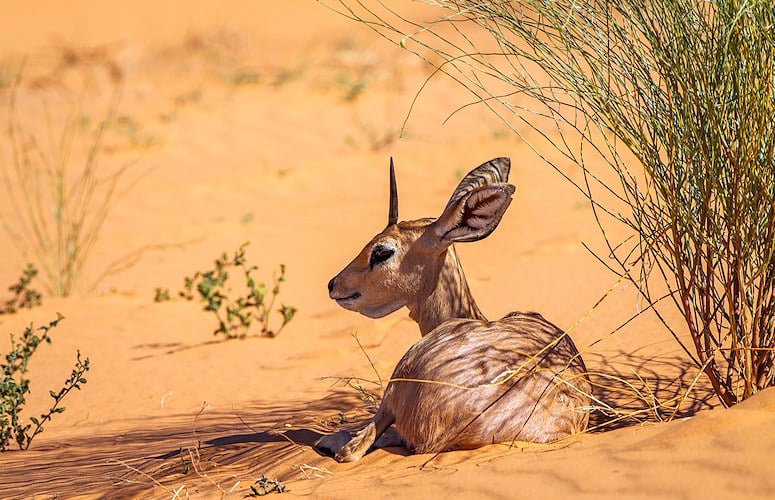
Steenbok occur widely across Southern Africa—from the Cape interior and Highveld of South Africa through Botswana, Zimbabwe, Namibia, and Mozambique—with local absences in true desert such as the Namib. Water-independent, they meet moisture needs from food and dew rather than permanent water. They favor open or lightly vegetated terrain where early detection and rapid evasion offset their small size and solitary habits.

Status
Steenbok are listed as Least Concern and remain common in suitable habitats, with many protected areas—including Kruger National Park—supporting stable populations. Abundance varies locally with vegetation, rainfall, and predation pressure. Although they face threats from habitat conversion, road mortality, and occasional hunting, broad distribution and adaptable behavior currently limit large-scale conservation risk across their range.

Habitat
Typical habitat includes open savanna, lightly wooded bushveld, and semi-arid grassland with scattered shrubs or termitaria for cover. Steenbok frequently rest in shallow forms—scrapes concealed by vegetation—and may dig to expose roots and bulbs. Independence from standing water allows occupancy of regions where permanent water is sparse, provided forage quality and visibility support early detection of approaching predators.

Social Organization
Steenbok are largely solitary and strongly territorial. Pairs may maintain overlapping home ranges yet forage apart, reuniting periodically. Territory size varies from small patches to larger blocks depending on forage, cover, and competition. Marking involves dung middens, urine, and interdigital gland secretions, with ritual scraping that scuffs sand or grit over scent to prolong signal life and reinforce boundaries with neighboring steenbok.
Finest Safari Areas in Africa for Encountering Steenbok
We recommend the following National Parks and Private Reserves for the best chances of spotting the steenbok on safari game drives and bush walks.
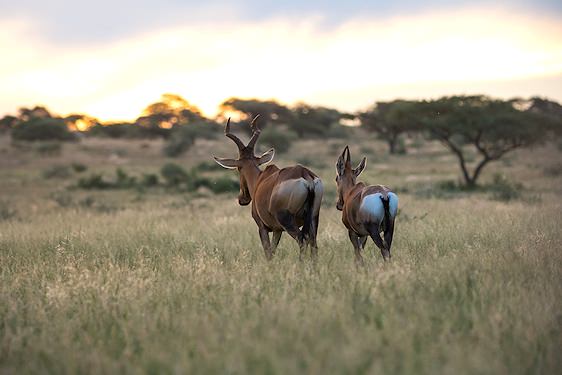

Social Behavior
Territorial behavior includes regular defecation and urination at boundary points, followed by scraping to cover deposits and extend scent life. When another steenbok approaches, postural displays and stamping escalate before any chase. Daily routines alternate between vigilant feeding bouts and short rests in shallow forms, with sudden, angular flight paths used to outmaneuver potential predators in sparse cover.

Reproduction
Pre-mating behavior may include the male lifting a foreleg between the female’s hind legs and mutual facial nibbling or rubbing. Sexual maturity is reached near seven to nine months, with breeding possible year-round and births peaking in the rainy season. Gestation lasts roughly 170–180 days, and the single newborn hides for several weeks before accompanying the mother on short foraging excursions.

Anti-Predator Behavior
Flight is the primary defense. On detecting danger, steenbok freeze, then explode into rapid, zigzag sprints toward cover. Principal predators include caracal and serval, with opportunistic predation by other carnivore such as jackal and larger wild cat. Fawns rely heavily on concealment, remaining tucked in grass clumps while the mother feeds and returns for brief nursing visits.