


Description
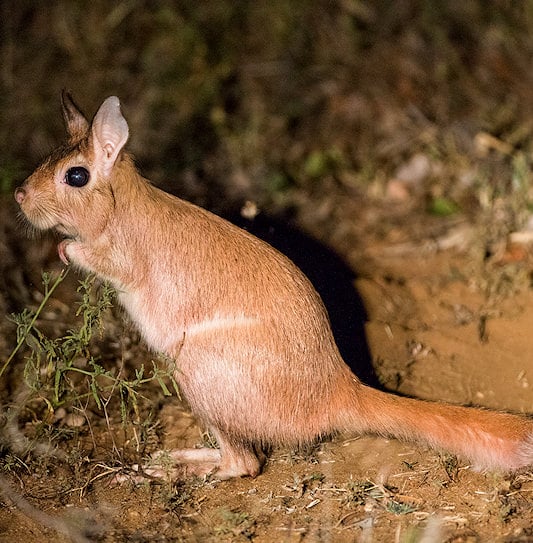
Springhares are distinctive nocturnal rodents rather than true hares, with powerful hind legs, long tails tipped in black, and large eyes adapted for night vision. Their coat shows warm ginger tones that blend with sandy soils, while relatively small ears reduce heat loss in arid habitats. On night drives, quick bounding gaits and tail flashes are often the first clues to a sighting.
Springhares are nocturnal animals and are not commonly seen during the daytime. They are one of the creatures many people hope to encounter on sunset or night drives in the Kruger National Park. I have most often seen them around the Letaba area during the summer months when the gates open while it is still dark. Spotting them properly usually requires a spotlight, as they are mainly active during the hours of darkness.
 - Mary-Anne Finlay - Tour Guide Since 2006 (THETA Registration No: GP 2432)
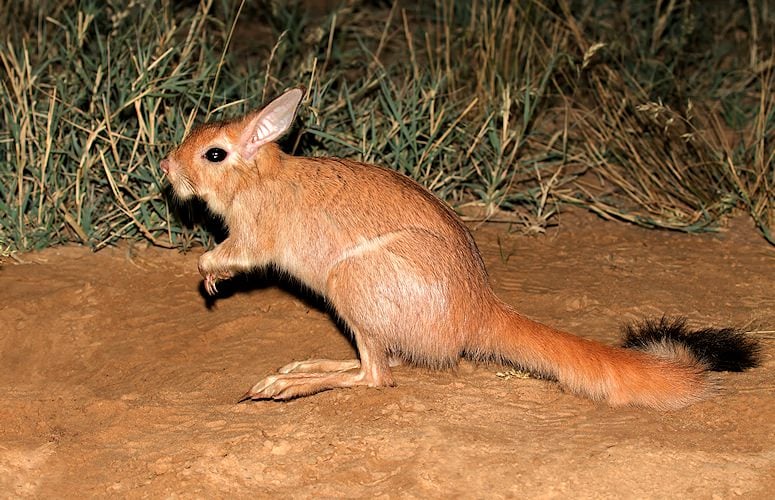
Springhares occur in parts of Angola, Zambia, Zimbabwe, non-coastal Namibia, Botswana, southern Mozambique, Eswatini, and South Africa. The Namib Desert offers too little vegetation for sustained foraging. They are absent from most fynbos-rich Cape provinces, with southernmost habitats in the Eastern Cape. Populations are most stable where sandy soils, sparse cover, and nocturnal foraging opportunities coincide with limited disturbance.

Status
Springhares are assessed as Least Concern across a wide range, though local abundance varies with rainfall, soils, and land use. Reliable population estimates are scarce, but persistence is buoyed by adaptable foraging and burrowing behavior. Sustainable subsistence use occurs in some regions of Botswana and South Africa, with current offtake unlikely to threaten overall viability where habitat quality remains intact.

Habitat
Preferred habitat includes sandy, fine-textured soils that allow rapid excavation of protective burrows. Dry riverbanks, arid bushveld, open savanna, and overgrazed plains provide the sparse cover and open ground suited to bounding movement and nighttime grazing. Burrow systems buffer temperature extremes and reduce predation risk, with entrances often near foraging patches to minimize exposure during nightly surface activity.

Social Organization
Springhares may occur singly, in pairs, or in small neighborhood clusters centered on burrow networks. Several burrows, sometimes three or four, can occur in close proximity and may be used by related individuals. Home ranges are compact—on the order of a few hundred square meters—with nightly routes linking burrow mouths, open feeding patches, and dusting sites that help maintain fur and deter ectoparasites.
Finest Safari Areas in Africa for Encountering Springhare
We recommend the following National Parks and Private Reserves for the best chances of spotting the springhare on safari game drives and bush walks.

Social Behavior
Primarily nocturnal, springhares emerge after dusk to graze and dig, sometimes making short visits to water. Activity concentrates within well-known paths that connect burrow entrances and open patches. Where resources are dense, as many as several dozen springhares may occupy a loose neighborhood. Daytime movement is mostly underground, with surface bouts brief and cautious to reduce detection by predators.

Reproduction
Springhares reach sexual maturity near 2.5 kg, with timing influenced by local conditions. Breeding can occur year-round, and gestation lasts roughly two to three months. Litters commonly number one, with young remaining in secure burrows for several weeks. Eyes open after about three days, and independence typically follows within seven weeks as juveniles begin short foraging bouts near the natal burrow.

Anti-Predator Behavior
Flight is the primary defense. At the first hint of danger, springhares bound in rapid arcs toward burrow entrances, using powerful hind legs and abrupt direction changes to break pursuit. Principal predators include caracal and serval, with opportunistic take by other carnivores where overlap occurs. Tail tips may flick during sprints, aiding coordination and startling would-be chasers at close range.