


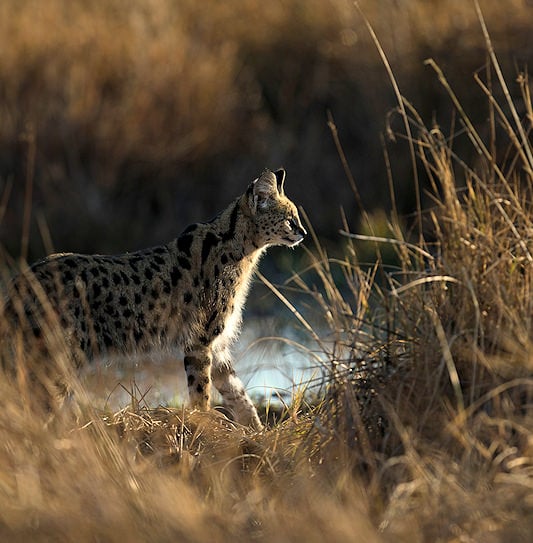
Description
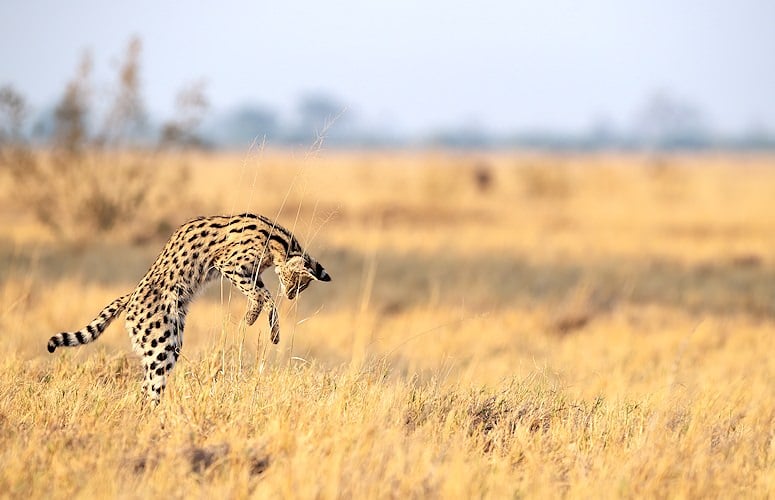
The serval is a slender, medium-sized cat with very long legs, oversized ears, and a golden coat patterned with bold black spots and stripes. It favors moist, tall grasslands and wetland edges where cover and small rodents are abundant. Mostly nocturnal, it relies on keen hearing and a high, vertical pounce to catch prey in dense vegetation.
This is another cat that is very, very elusive, and I can count on one hand the number of times that I have seen one. The areas where I have most commonly encountered them have been around the Sabie River and Sand River areas near Skukuza, as well as around Satara, especially between the N’wanetsi and Sweni Rivers. Servals are solitary cats and are usually only seen together if it is a mother with cubs or a mating pair. In all likelihood, if you do see one, it will be a single animal.
 - Mary-Anne Finlay - Tour Guide Since 2006 (THETA Registration No: GP 2432)
Serval occur in suitable habitats across much of sub-Saharan Africa, including South Africa’s Lowveld and Kruger National Park, as well as parts of Mozambique, Namibia, Botswana, Zimbabwe, and Zambia. Distribution is patchy, often tracking wetlands and tall grass communities.

Status
As a species, the serval is listed as Least Concern with a wide African distribution. Abundance is typically low and localized, but populations are stable in many protected areas where habitat is intact.

Habitat
Large ears and long legs help serval locate and pounce on small prey concealed in medium to tall grass. Diet centers on rodents, with birds and other small animals taken opportunistically. Preferred habitats include moist grasslands, marsh edges, and open woodland with grassy understory.

Social Organization
Serval are solitary for most of the year. Home ranges may overlap, especially at the edges, and individuals typically avoid direct contact. Males and females meet to mate, and females rear dependent young alone.
Finest Safari Areas in Africa for Encountering Serval
We recommend the following National Parks and Private Reserves for the best chances of spotting the serval on safari game drives and bush walks.




Social Behavior
Serval mark objects near core areas with scent, then hunt by listening for subtle movements before a swift, vertical pounce. Encounters with other serval are limited to mating or a female caring for kittens. Activity is largely nocturnal and crepuscular, with daytime rest in cover.

Reproduction
When a female is in heat, a pair may travel together briefly while mating. Gestation lasts about 66–75 days. Typical litters are two to three kittens, with one to five possible. The mother shelters the young in concealed sites and rears them alone.

Anti-Predator Behavior
Serval avoid larger carnivores and typically slip into cover or flee when threatened. Predators include hyena and leopard; conflict with other small cat species is usually avoided through spacing and display rather than direct fights.