


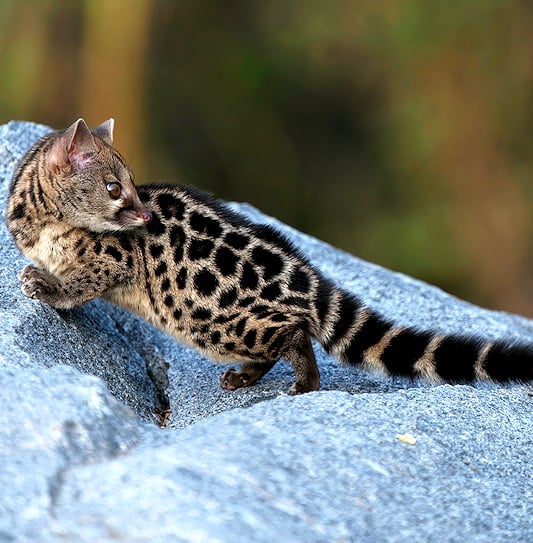
Description
The large-spotted genet is a slender, nocturnal carnivore in the civet and genet family (Viverridae). It has a long, banded tail used for balance, a pointed muzzle, and a pale coat scattered with bold, dark spots. Agile and cat-like in movement, it hunts along thickets and often rests or forages in trees, especially on warm nights.
This is another one of our nocturnal animals. These creatures are very shy and are one of the animals that many people hope to see while doing a sunset or night drive in the Kruger National Park. There are a few camps in the park where one may be lucky enough to spot them. The first is Berg-en-Dal Camp. If one gets up early in the morning and listens carefully for rustling in the trees, one can sometimes spot them moving through the branches as they head back to their hiding places for the daytime. The second camp is Letaba Rest Camp. There is a group of genets living in the roof area near the restaurant. If one goes for dinner around sunset, one might be lucky enough to see one peeking out from the holes near the leadwood support beams before heading out for the night to forage. The last camp where I often look for them is Punda Maria, usually during the late evenings or early mornings, again listening for rustling in the trees and using a spotlight to help locate them.
 - Mary-Anne Finlay - Tour Guide Since 2006 (THETA Registration No: GP 2432)
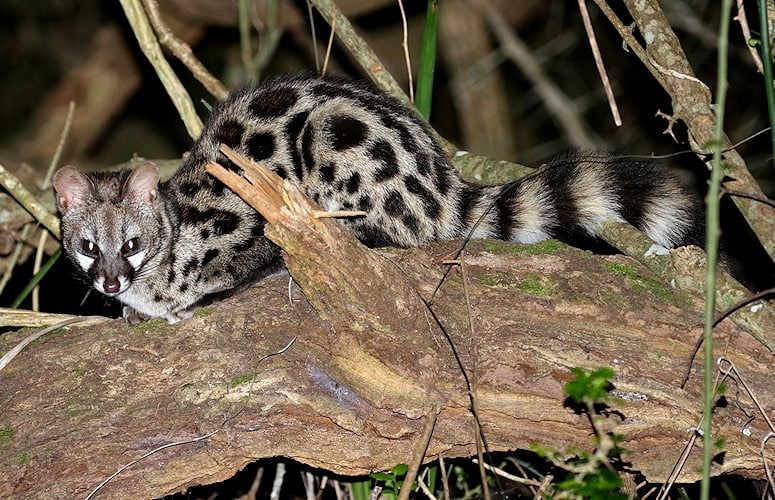
In southern Africa, this species is widespread in suitable habitats across much of South Africa and neighboring regions. It favors mesic shrublands, fynbos edges, woodland and grassland ecotones, and riparian thickets. It is generally absent from extremely arid zones such as the Kalahari and Namib Deserts and much of the Karoo semidesert.

Status
Large-spotted genet is commonly recorded in protected areas and adaptable across mosaics of natural and human-modified habitats. Regionally it is not considered threatened, with stable populations where suitable cover and prey remain available.

Habitat
It prefers edges—fynbos meeting thicket, woodland bordering grassland, and riverine strips—where cover and prey density are high. Diet is varied: small mammals and reptiles, birds, insects, scorpions, and fruit. Foraging is typically crepuscular to nocturnal, with frequent tree use for resting and hunting.

Social Organization
Genet is mostly solitary. Male and female home ranges may overlap; females with dependent young can be seen together temporarily. Home-range size varies with habitat quality and prey availability; males may range more widely than females.
Finest Safari Areas in Africa for Encountering Large-Spotted Genet
We recommend the following national parks and private reserves for the best chances of spotting the large-spotted genet on night drives and quiet evening game drives.


Social Behavior
Scent marking (urine, feces, glandular secretions) communicates presence, sex, and reproductive state. Individuals re-mark key sites frequently along paths and den trees. Vocalizations include grunts and growls at close range; when disturbed, a raised-hair posture increases apparent size.

Reproduction
Breeding in southern Africa often peaks in late summer to autumn. After a gestation of about 70–77 days, females give birth to a litter of two to three kittens in a sheltered den. Females can breed from roughly two years of age; juvenile survival varies with prey and predator pressure.

Anti-Predator Behavior
When threatened, a genet may emit strong anal-sac secretions, arch the back, bristle the tail, and use short growls. Primary defense is rapid retreat into dense cover or trees, where agility and balance, aided by the long tail, help it evade pursuit.