• USD
  • EUR
  • GBP
  • AUD
  • CAD
  • ZAR

South Africa's Tsitsikamma National Park

Help Me Plan

Tsitsikamma National Park Destination Guide

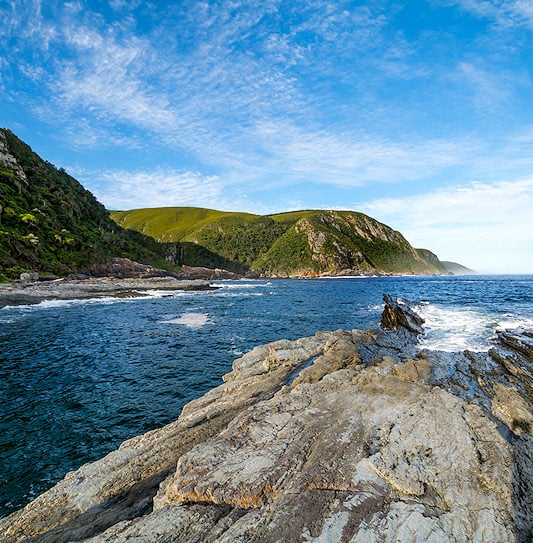
Tsitsikamma National Park protects a dramatic mix of rugged coastline, river gorges, and indigenous forest along South Africa’s Garden Route. The closest major city is Gqeberha (Port Elizabeth), 141 km to the east. Visitors come for the Otter Trail, Storms River suspension bridges, birding, kayaking, and year-round adventure amid lush, evergreen scenery.

Getting There

By Air: The Tsitsikamma region spans parts of the Western and Eastern Cape and can be accessed from the west or east. Guests will be welcomed at OR Tambo International Airport or Cape Town International and assisted in transferring to a domestic flight to either George or Chief Dawid Stuurman International Airport (Gqeberha), depending on the itinerary.

By Road: The area is approximately 200 km west of Gqeberha (Port Elizabeth) and 70 km east of Plettenberg Bay. Guests enjoy one of South Africa’s most scenic drives in a private, air-conditioned vehicle. The region is commonly combined with safari areas such as Addo Elephant National Park.

Weather & Best Time To Visit

Tsitsikamma has a moderate climate, with rainfall in both summer and winter, often at night. Daytime activities can be enjoyed throughout the year, making the evergreen landscape ideal for adventure seekers. Rainfall is typically highest from May to October.

Tsitsikamma is accessible year-round, with November to April the peak season. Ocean and river temperatures drop during winter (April to September) but remain comfortable for water-based activities with appropriate gear.
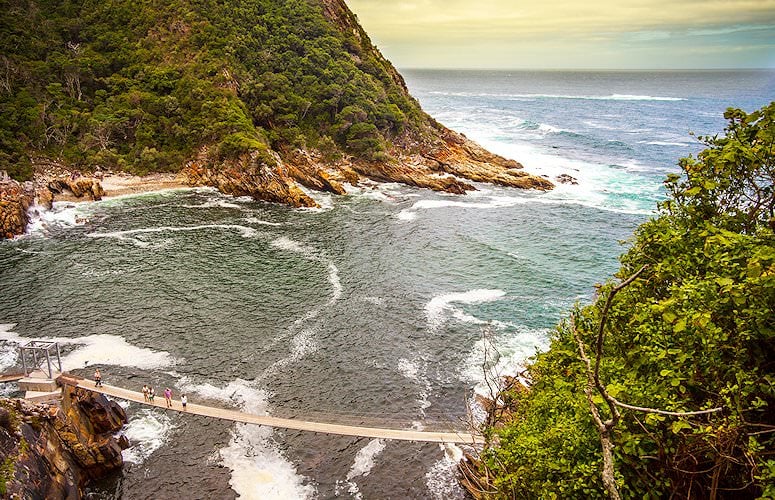
Storms River Mouth and suspension bridge at Tsitsikamma

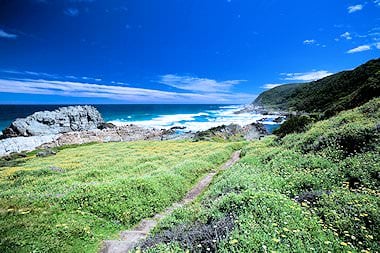
Tsitsikamma is a rambler’s dream. Twelve hiking trails lead into an enchanting world of tangled forest dominated by giants such as Outeniqua yellowwood, bastard ironwood, and stinkwood. The main trail is the Otter Trail (~42 km), widely considered South Africa’s finest coastal walk. It runs west from Storms River Mouth to Nature’s Valley, traversing beaches, rocky shores, ravines, and fynbos-clad plateaus.

Province
Western & Eastern Cape
Coastline
~80 km
Established
1964 (now part of Garden Route National Park)
Managed by
SANParks
Nearest airports
George; Chief Dawid Stuurman (Gqeberha)
Signature trail
Otter Trail (5 days)
Biome
Afrotemperate forest & fynbos

Safaris and Tours that visit Tsitsikamma

Tsitsikamma is a scenic destination on the Garden Route, within easy reach of Cape Town and Addo, and offers a wealth of outdoor activities.
10 Days From: USD 3,092 - 4,900 pp Personal & National Park Camps Code: T17

From the cosmopolitan city of Cape Town to the Overberg and Garden Route regions, this private tour ends with a safari in Addo for a well-rounded experience.
7 Days From: USD 6,221 - 9,229 pp Luxury Code: T04

This luxury adventure pairs the Garden Route with an unforgettable safari at Shamwari, a premier private game reserve in South Africa’s south.
4 Days From: USD 1,045 - 1,672 pp Personal Code: T21

Departing and returning to Cape Town, this short private tour explores Garden Route highlights from a base on the shores of the Knysna Lagoon.


Reasons to visit Tsitsikamma National Park

1

Birdlife

Tsitsikamma National Park is home to many bird species. Birders can explore pristine habitat via multiple hiking trails. You will often hear them calling overhead in the forest canopy — keep a lookout for the Knysna turaco (loerie) and grey cuckooshrike.

2

The Otter Trail

Tsitsikamma hosts the world-famous Otter Trail along the southern coastline of Africa. The full trail takes several days and must be booked well in advance. The first section, the Waterfall Trail, is open to day visitors and is manageable for most hikers.

3

Storms River

Storms River and its activities are major drawcards. Kayak through the gorge, try black-water tubing, ride horses, enjoy canopy or zip-line tours, or hike the coastline. The river mouth is the start of the Otter Trail and a must-see.

Start Planning

Experiences to Savor at Tsitsikamma National Park

Your most memorable experiences will connect the indigenous forest with the rugged coastline.
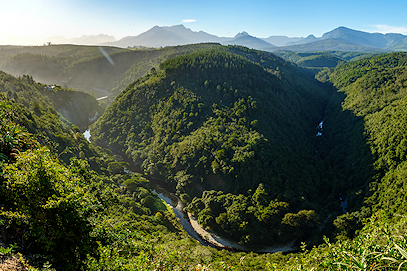
Zip-line or canopy tour through Tsitsikamma forest

Zip It!

The best way to view Tsitsikamma’s canopy is from above. We can arrange a forest canopy tour or a zip-line across the Tsitsikamma Falls for sweeping views.
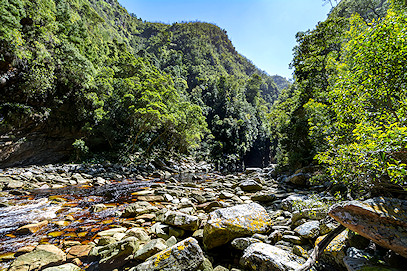
Picnic site surrounded by indigenous forest

Forest Fresh

A hike into the Tsitsikamma forest or a picnic at one of the sites placed within its reaches calms the senses and relaxes the mind amid pristine flora.
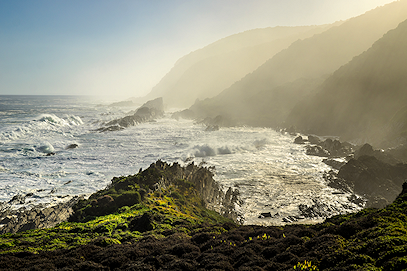
River cutting through forested gorge into the Indian Ocean

Forest to Ocean

Follow a river from the forested escarpment through gullies and streams to its final destination — the Indian Ocean — for a rewarding, varied excursion.

Useful Information

History

Tsitsikamma is a Khoikhoi word where tsi means “clear” or “clean” and kamma means “water” or “river.” It can be translated as “clear, clear water” or “clear river.” The Khoikhoi were nomadic pastoral people who moved seasonally to graze livestock. The group associated with the area, the Houteniqua, means “man laden with honey.” The Khoikhoi arrived in the southern Cape between 2,500 and 2,000 years ago.

Shell middens indicate that Stone Age people occupied the coast long before the Khoikhoi. Europeans arrived in the eighteenth century. Tsitsikamma National Park is now grouped with Wilderness and Knysna as Garden Route National Park. Upon establishment, a marine protected area was incorporated along roughly 80 km of coastline — among the earliest marine national park initiatives in Africa — with a no-take policy that provides a baseline for fisheries research.

Wildlife

The animals most likely to be encountered are chacma baboon and vervet monkey — do not leave food unattended. Numerous antelope occur, the most common being bushbuck; other antelope include common duiker, steenbok, grysbok, klipspringer, and blue duiker. The secretive Cape mountain leopard is the largest predator and is mostly seen on camera traps. Caracal is occasionally spotted, and Cape clawless otter may be seen entering the ocean before high tide. From the cliffs, southern right whale and humpback whale are visible in season. Indo-Pacific bottlenose dolphin occurs year-round.

Several bat species emerge at dusk to feed on insect. Nocturnal species like large-spotted genet, bushpig, porcupine, and striped polecat move during the small hours. The indigenous forest is rich in birdlife; the Knysna turaco is the best known. Daytime calls include red-chested cuckoo, Knysna turaco, and Burchell’s coucal; at night, listen for Cape eagle-owl, spotted eagle-owl, fiery-necked nightjar, and common thick-knee. In pristine forest, the beautiful Narina trogon rewards patient birdwatchers. On calm nights, fireflies add a touch of magic.

Vegetation & Terrain

Tsitsikamma is known for cliffs, deep river valleys, and the ancient Cape Fold Mountains to the north. The bedrock consists largely of heavily weathered, jointed metamorphic and sedimentary rocks. Along the coast, weaker zones have weathered along joints, forming parallel gaps that resemble slices. Geologically, Tsitsikamma falls within the Table Mountain Group of the Cape Supergroup, deposited in shallow marine environments roughly 510–400 million years ago.

The park is best known for lush indigenous forest with towering yellowwoods. Other notable trees include red elder, Cape ash, hard pear, and black stinkwood. Lianas such as “monkey-rope” aid arboreal movement. The area also supports multiple fynbos types (including restio- and asteraceae-rich communities) and semiaquatic and aquatic plants, such as reeds, sedges, bulrushes, pondweed, and seagrass.

Activities

Tsitsikamma is an adventurer’s paradise. A favorite is kayaking up Storms River through a dramatic gorge. Another highlight is the Big Tree, a 36.6 m Outeniqua yellowwood with a 9 m circumference. Forest canopy tours and zip-lines carry visitors over giant ferns and ravines.

The world-renowned Otter Trail is a five-day hiking expedition that must be booked well in advance. The Waterfall Trail — the first section of the Otter — is an excellent day walk of about three hours (allow extra time for swimming at the falls). Adrenaline seekers can leap from Bloukrans Bridge, one of the world’s highest bungee jumps. Mountain biking, Segway tours, tubing, golf, scuba diving, and more are available nearby — let us know your preferences.

Last Updated: November 21, 2025 Curated By: Riaan Viljoen