


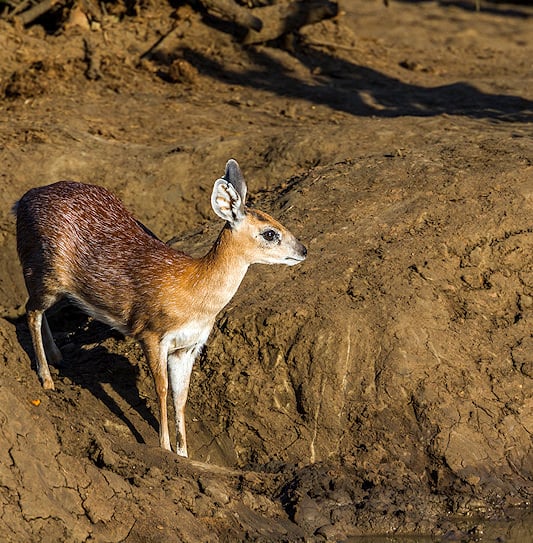
Description
Sharpe’s grysbok is a small, shy antelope with a rich reddish coat flecked with white, a lightly grayish face, and short, widely spaced horns on males. It favors dense thickets and woodland edges where cover is abundant. Mostly nocturnal and solitary, it emerges at night to browse on leaves and shoots, freezing or hiding when threatened.
Sharpe’s grysbok are always a special little antelope to find. They are shy, mostly solitary, and usually disappear into cover very quickly. I have only ever seen them north of the Letaba River, and some of my favourite areas to look for them are the dirt roads around Mopani Camp and the Red Rocks road near Shingwedzi. If you do see one, take your photograph quickly, as they have a reputation for scrambling away almost immediately.
 - Mary-Anne Finlay - Tour Guide Since 2006 (THETA Registration No: GP 2432)
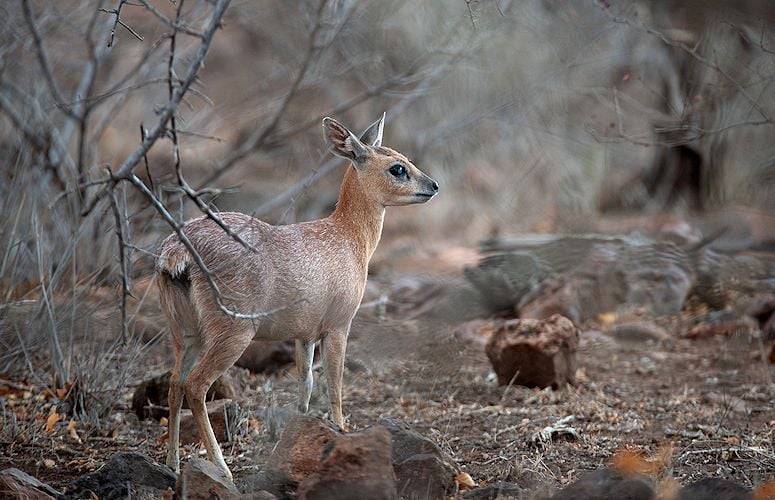
Their distribution ranges from parts of Tanzania south of Lake Victoria through Mozambique, eastern Zambia and eastern Zimbabwe to the Kruger National Park and the eastern parts of South Africa.

Status
In South Africa, Sharpe’s grysbok is listed as Least Concern and is widely distributed in suitable habitats. Populations can be patchy but are stable in many protected and private areas.

Habitat
Most small antelope require cover; Sharpe’s grysbok favors dense shrub and woodland margins, including miombo and thorny thickets. Thick vegetation shelters newborn young and provides concealment from predators. In Kruger, it is associated with wooded areas and thickets rather than open plains.

Social Organization
Sharpe’s grysbok is territorial and largely solitary, though male–female pairs may share a territory. Disputes are settled with short horn clashes and posturing. Territory size varies with habitat quality and local density.
Finest Safari Areas in Africa for Encountering Sharpe's Grysbok
We recommend the following National Parks and Private Reserves for the best chances of spotting sharpe's grysbok on safari game drives and bush walks.

Social Behavior
Like duiker, Sharpe’s grysbok is mainly nocturnal, resting in thickets by day and emerging at night to feed. Pairs may share and scent-mark territory boundaries with feces and urine. Young typically remain within the parental range until independent, after which males seek their own territories.

Reproduction
Breeding may occur year-round, with births often peaking at the start of the rainy season. Courtship includes leg-lifting, licking, and rubbing. Males and females can reach sexual maturity from about 6 to 19 months. Gestation lasts approximately 5.6–7 months, and one to two young are born.

Anti-Predator Behavior
When danger approaches, the first response is to freeze or hide. Sharpe’s grysbok often crouches low in cover or shelters in abandoned burrows made by aardvark or other mammals, fleeing only as a last resort into denser vegetation.