


Description
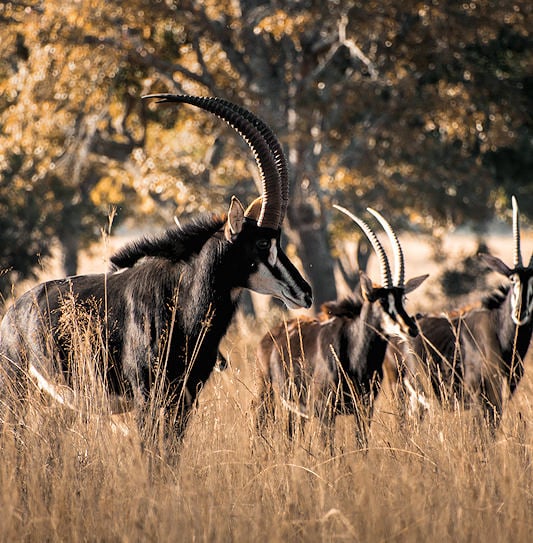
The sable antelope is a large, powerfully built antelope recognized by long, scimitar-shaped horns and a striking black-and-white mask. Mature bulls are glossy black with white underparts, while cows and young are chestnut. The species favors lightly wooded savanna near water and moves in cohesive, territorial herds with a single dominant bull.
What a treat it is when you get to see this antelope. They are also considered rare in the Kruger National Park, although not quite as rare as roan antelope. They are more commonly found in some of the southern areas of the park, particularly along the tar road between Pretoriuskop and Skukuza. Good areas to look for them are both the tar and dirt roads between Skukuza and Tshokwane, as well as the Salitjie Road, the S30, which runs along the Sabie River between Skukuza and Lower Sabie.
 - Mary-Anne Finlay - Tour Guide Since 2006 (THETA Registration No: GP 2432)
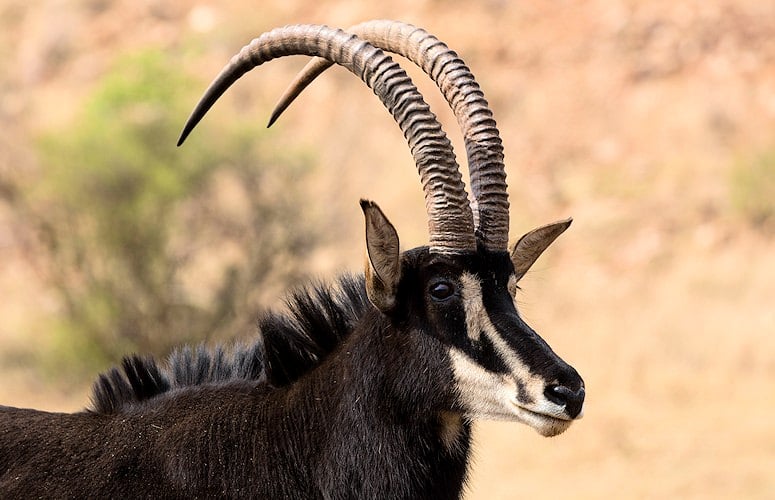
Sable antelope occur in scattered areas within Botswana, South Africa, Zambia, Tanzania, Mozambique, Zimbabwe, and Angola. In South Africa, they occur in Kruger National Park and other national parks as well as private game reserves.

Status
The southern sable has robust populations in parts of Southern Africa. As a species, the sable antelope is listed as Least Concern. The giant or royal sable of Angola is Critically Endangered, and the Zambian (kirkii) form is of conservation concern in parts of its range. Overall, populations are patchy and locally reduced.

Habitat
Sable thrive in lightly wooded savanna and grassland mosaics, feeding mainly on grasses and accessible leaves. In Kruger National Park their distribution is patchy. They favor areas with medium-tall grasses, reliable drinking water, sandy or well-drained soils, scattered trees, and small shrubs, and they are selective about local habitat structure.

Social Organization
Like many herbivores, sable organize into herds of about 10–30 calves and females led by a single male. Young or ousted males form bachelor groups, typically up to a dozen males. At roughly three years of age, most young males disperse to join these groups, while females generally remain in their natal herd.
Finest Safari Areas in Africa for Encountering Sable
We recommend the following National Parks and Private Reserves for the best chances of spotting the sable on safari game drives and bush walks.

Social Behavior
Sable are most active during the day, alternating grazing and browsing. Males may fight for dominance by dropping to their knees and clashing with their long, scimitar-shaped horns, a ritual that seldom causes serious injury. When large herds split, a new dominant bull typically emerges. Older males may live solitary, nomadic lives.

Reproduction
The dominant male mates with females in the herd, often seasonally, so calves are born in the rains when resources peak. Sable generally breed at 2–3 years of age. Gestation lasts about nine months. A cow usually gives birth to a single calf and nurses it as the primary food source until roughly eight months of age.

Anti-Predator Behavior
The sable’s main predators are spotted hyena, leopard, crocodile, lion, and packs of wild dog. Unlike many antelope, sable sometimes fight back, occasionally injuring an attacker. Smaller predators, such as a single hyena, wild dog, or jackal harassing a herd, are chased off. Their ringed, scimitar-shaped horns can fatally injure predators.