


Description
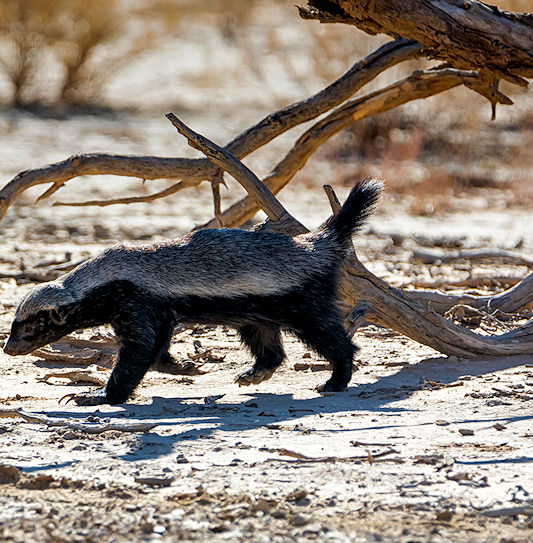
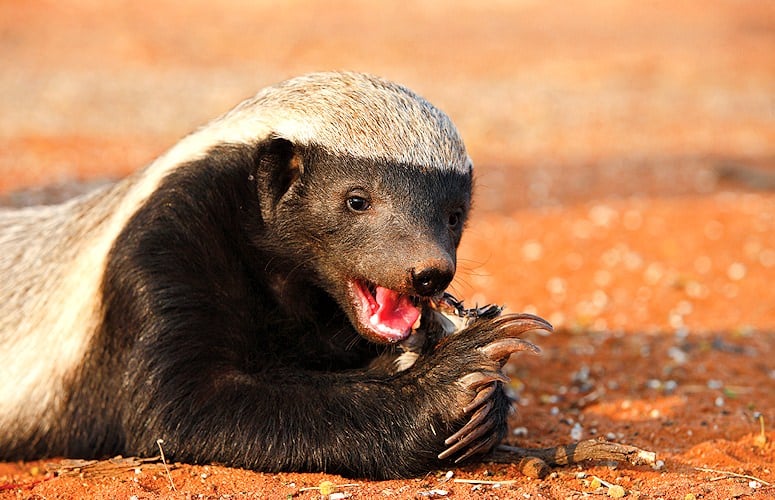
The honey badger is a stocky, low-slung mustelid with a distinctive pale mantle from crown to tail contrasting with black sides and underparts. Thick, loose skin and powerful forelimbs with long claws aid digging and defense. Elusive and mostly nocturnal in warm seasons, honey badger is rarely seen, making sightings especially memorable.
Honey badgers are fascinating but very difficult animals to find. They have a grey stripe along the back with black underneath and are known for being incredibly tough. They are usually seen alone, although pairs are sometimes encountered. A good clue is watching for something bouncing through the grass. Good areas to look for them are along the Salitjie Road between Skukuza and Lower Sabie and around Satara Rest Camp, where they sometimes raid bins.
 - Mary-Anne Finlay - Tour Guide Since 2006 (THETA Registration No: GP 2432)
Distribution
Honey badger occurs widely across sub-Saharan Africa, including all countries of Southern Africa, in habitats ranging from arid savanna to woodland and semi-desert. Local color and size vary slightly across the range. Sightings in Kruger National Park are possible but uncommon due to secretive habits and large home ranges.

Status
Honey badger is generally assessed as Least Concern due to wide distribution and adaptability, though populations can decline locally from persecution, by-catch, and habitat change. Density is naturally low, and ranges are large, so encounters are infrequent even where the species is present.

Habitat
Honey badger uses a broad habitat spectrum, from Kalahari dunes to mopane and miombo woodland, thornveld, and floodplains. A varied diet—including insects, larvae, small vertebrates, reptiles, and carrion—reduces competition with larger carnivore. Powerful digging allows access to burrows, roots, and hive remnants in compact soils and termitaria.

Social Organization
Honey badger is primarily solitary. Adults maintain overlapping home ranges and use strong scent from anal glands for communication and marking. Courtship and mating are seldom observed. Individuals may tolerate one another briefly at rich food sources, but long-term pairing is unusual.
Finest Safari Areas in Africa for Encountering Honey Badger
We recommend the following national parks and private reserves for your best chance of seeing honey badger on guided game drives and night drives.


Social Behavior
Invertebrates form a large part of the diet, supplemented by small mammals, birds, reptiles, and carrion. Honey and bee brood are taken opportunistically. Honey badger shows notable toughness and some resistance to certain venoms, but it is not immune. Communication includes scent-marking, postures, grunts, and growls, with louder calls mostly given in distress.

Reproduction
Mating can occur year-round. After a gestation of roughly six months—sometimes extended by delayed implantation—females usually give birth to one, occasionally two, cubs in a grass-lined burrow. Cubs remain with the mother for many months as she teaches foraging and digging, and independence is gradual.

Anti-Predator Behavior
Adult honey badger has few natural predators, though large carnivore may occasionally take individuals, and cubs are vulnerable. Defense includes pilo-erection, aggressive posturing, loud vocalizations, and slashing bites with powerful jaws. Thick, loose skin can reduce damage from bites while the animal twists free.