


Description
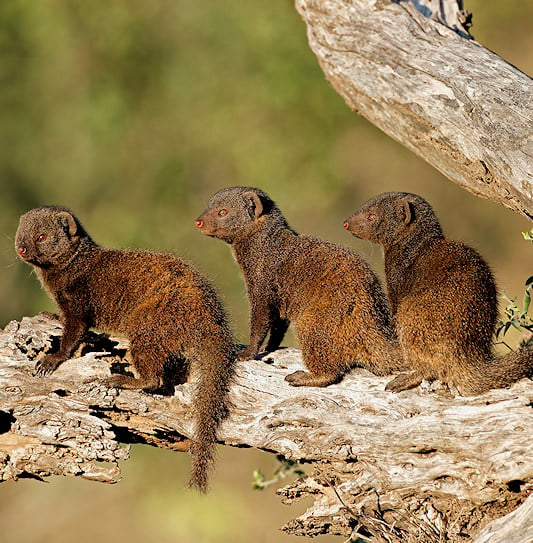
Small, social carnivore with dark eyes, a pointed muzzle and a uniformly gray to brown coat over an orange-brown underfur. Adults are tiny—about 18–28 cm long—and often seen sunning or foraging on termite mounds. Look low along roadsides and camp edges; groups pop in and out of cover with quick, chirruping contact calls.
This little critter is probably my favourite animal in the Kruger National Park. They are often accompanied by a southern yellow-billed hornbill, and one commonly sees them crossing roads through grassy areas as they move from one side to the other. They are very, very shy animals, and one is not always rewarded with them posing nicely for photographs. However, for those wanting good photographs of dwarf mongooses, one of the best areas to look for them is along the dirt roads around Pretoriuskop Rest Camp.
 - Mary-Anne Finlay - Tour Guide Since 2006 (THETA Registration No: GP 2432)
They inhabit a significant portion of Africa south of the equator. They occur in Mozambique and parts of Zimbabwe, Botswana, Namibia, Zambia and Angola, as well as in the northern parts of South Africa, where the Kruger National Park is situated. Like other species of mongoose, they avoid desert areas.

Status
Dwarf mongoose are considered of Least Concern and face no immediate rangewide threats. They reach high densities in open savanna and woodland—often around 30 per square kilometer—though distribution is limited by arid zones. Most mongoose species are likewise assessed as Least Concern in suitable habitat and protected areas.

Habitat
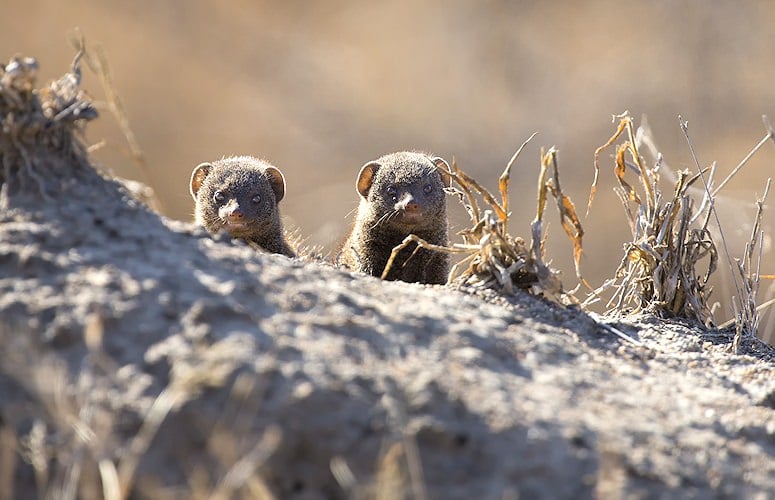
These feisty carnivore live in open savanna, woodland and grassland. Termite mounds near roads and camps—such as the plains around Satara in Kruger—are prime resting and lookout spots. Diet includes snake, bird, rodent and insect, with minimal competition beyond other mongoose that share similar small-predator niches.

Social Organization
Groups typically include 7–9 members with a dominant breeding pair. Clans groom, babysit and forage cooperatively, defending territories with scent marking along boundaries. Adults fill roles as sentry, forager or caretaker, while juveniles remain close to cover and learn routes between foraging patches and safe refuges.
Finest Safari Areas in Africa for Encountering Dwarf Mongoose
We recommend the following national parks and private reserves for the best chances of spotting dwarf mongoose on game drives and guided bush walks.

Social Behavior
Dwarf mongoose are diurnal and weather-sensitive: mild conditions favor activity, while rain or cold prompts resting. After foraging bouts, groups engage in social grooming and play. Contact is maintained with high-pitched calls whose tone and sequence convey information about movement, food finds and potential threats.

Reproduction
Females may conceive from about 15 months. During estrus, the vulva swells and reddens for roughly four days. Courtship includes licking and sniffing, followed by repeated copulations; only a fraction are successful. Litters of 1–6 are typical, and breeding can occur 2–3 times per year with helpers assisting pup rearing.

Anti-Predator Behavior
When a predator appears in the open, groups scatter to nearby holes or mounds rather than bunching. Loud alarm calls alert neighbors and may deter approach. Eagle—such as the sizable martial eagle—are frequent hunters; the sudden overhead shadow elicits immediate dashing for cover and sentinel scanning.