


Description
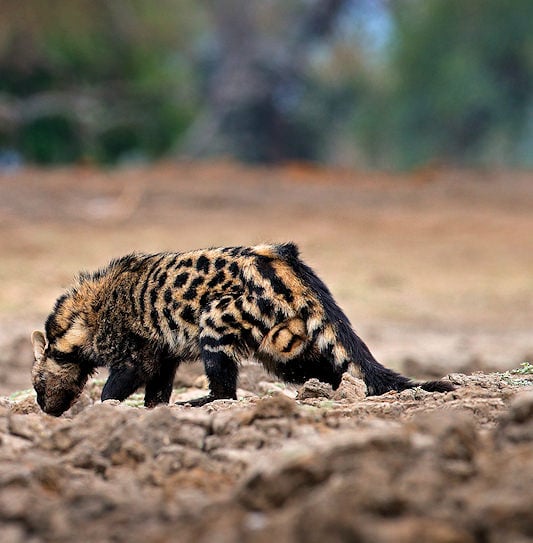
Stocky, low-slung carnivore with a black-and-white facial mask, bold blotches over a grizzled gray coat, and a ringed tail. A raised dorsal crest stands when alarmed. Mostly solitary and nocturnal; sexing in the field is difficult. Look for a waddling gait and reflective eyes along riverine thickets on dusk and night drives.
Civet, also known as the tabby cat of the bushveld, is a very shy creature and far more nocturnal than diurnal. Areas where I have often spotted civets are along the Sabie River between Skukuza and Lower Sabie, as well as along the S100 that follows the N’wanetsi River.
 - Mary-Anne Finlay - Tour Guide Since 2006 (THETA Registration No: GP 2432)
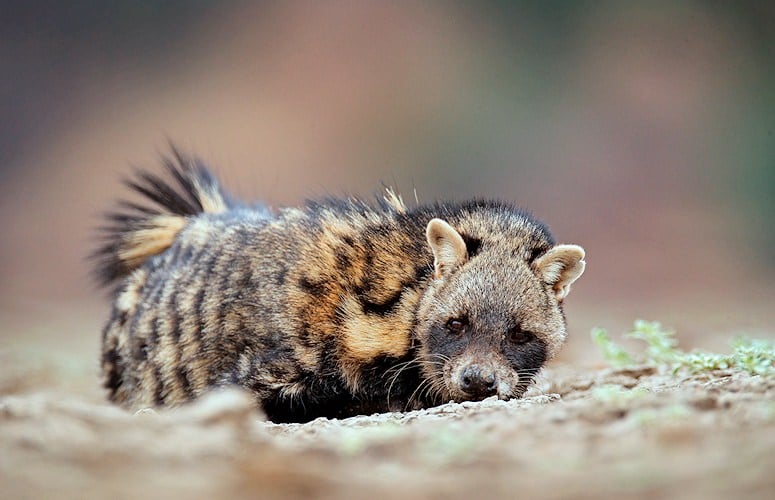
In South Africa, African civet are naturally concentrated in the warmer northeast—Greater Kruger and parts of Limpopo and KwaZulu-Natal—with scattered occurrences elsewhere in suitable habitat. More broadly, they are widespread across much of sub-Saharan Africa, including Namibia, Botswana, Zimbabwe, Mozambique, and Zambia.

Status
Widely distributed and assessed as Least Concern. Their shy, nocturnal habits make sightings uncommon, but they remain locally common in protected areas like the Kruger National Park and adjoining private reserves. Local pressures include snaring and conflict near settlements.

Habitat
Favors well-watered savanna, woodland and riverine thickets that provide dense cover. Omnivorous: feeds on fruit (especially figs), berries and fallen marulas, plus beetles, termites, crabs, bird eggs, small reptile and rodent. Will scavenge opportunistically. Characteristic communal latrines (“civetaries”) mark home-range edges.

Social Organization
Mostly solitary and nocturnal; individuals maintain overlapping home ranges and communicate via scent marks and latrines. Daytime is spent resting in dense cover, emerging at dusk to forage along habitual paths.
Finest Safari Areas in Africa for Encountering Civet
Best chances are on guided night drives and at dawn/dusk along rivers and thickets.

Social Behavior
Regularly patrols set routes between day beds, foraging patches and latrines. Uses a keen sense of smell to locate prey and ripe fruit. Scent marking (musky secretions and fecal deposits) is frequent at boundaries.

Reproduction
Breeding may occur year-round. Courtship involves mutual sniffing and vocalizations. Gestation is roughly 60–80 days; litters of 1–4 are born in dense cover. Young remain concealed for several weeks before accompanying the mother.

Anti-Predator Behavior
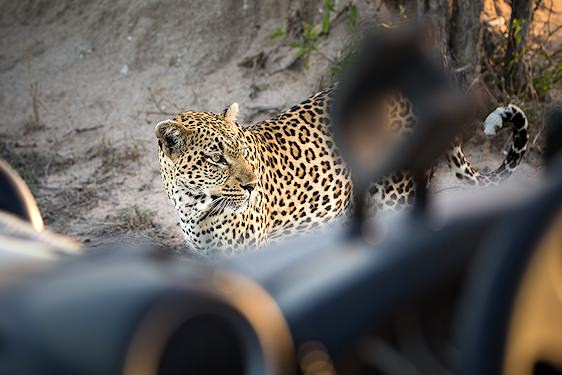
On threat, raises the dorsal crest, arches the back and may stand its ground briefly to appear larger before retreating to cover. Main predators include leopard, lion and spotted hyena; vigilance and dense vegetation are key defenses.