


Description
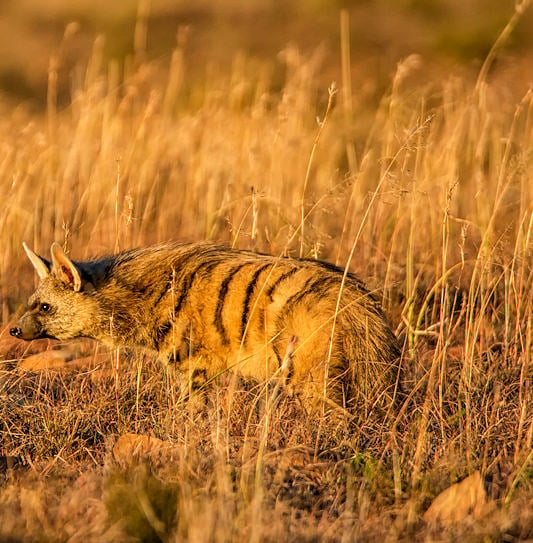
The aardwolf is a small, nocturnal insectivore with golden-brown fur and bold black stripes running vertically along its sides and legs. A shaggy coat and an erect mane protect the body while it forages for termite. Its slender muzzle, large ears, and light build help it locate colonies and feed efficiently after dusk.
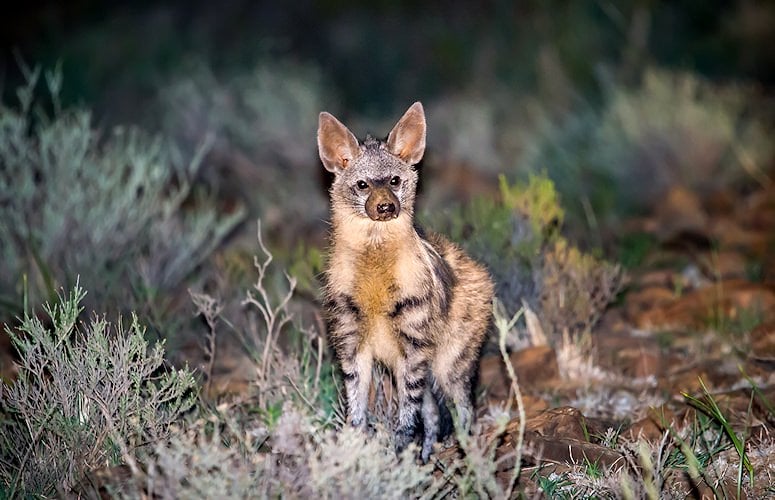
Aardwolf occur in two disjunct populations in eastern and southern Africa. Their distribution in Southern Africa includes the whole of South Africa and Botswana, along with most parts of Zimbabwe and Namibia and a few streaks of the south of Mozambique bordering South Africa. They are, however, not found in the harsher reaches of the Namib Desert in Namibia.

Status
Although seldom encountered, the aardwolf is assessed as Least Concern by the IUCN because it remains widespread and present in many protected areas. Densities are typically low—often around one individual per square kilometer—and its primary prey, termite, are abundant and resilient, supporting stable populations.

Habitat
They occur in most woodland, grassland, and savanna areas with significant cover for shelter. The key requirement is a steady, reliable food source. Like most insectivores, they den near termite mounds. Termite make up over 90% of their diet, with other insects like beetle and centipede forming the balance. A single aardwolf may consume hundreds of thousands of termite in a night, spacing raids so colonies recover. Sightings in Kruger are uncommon.

Social Organization
Aardwolf are most active at night because they follow the hours of their prey. They usually forage for termite alone and seldom encounter others of their species, apart from mothers with young and temporary associations during the breeding season. They rely on scent to detect individuals passing through and to locate potential mates.
Finest Safari Areas in Africa for Encountering Aardwolf
We recommend the following National Parks and Private Reserves for the best chances of spotting the aardwolf on safari game drives and bush walks.



Social Behavior
Scent marking or scent communication is frequent, as in many solitary carnivores. They paste secretions from anal glands onto plants, stumps, and rocks in their territory. Defecation in specific latrines is common, and they may bury the excrement like a domestic cat. They also communicate vocally during conflicts and other high-arousal encounters.

Reproduction
Whether pairs are consistently monogamous is uncertain, but males and females that have reproduced often share a roughly 2-square-kilometer territory with their offspring. In South Africa, breeding commonly occurs in mid-winter, with a gestation of about 90 days. Pups begin supervised foraging around three months and typically become independent by about a year, with care from both parents.

Anti-Predator Behavior
When under threat, aardwolf raise the mane to appear larger, similar to hyena. They rarely attack due to small size and weak bite; if intimidation fails, they flee, often with the tail held high to distract a pursuer, and head for burrows or dense cover.