


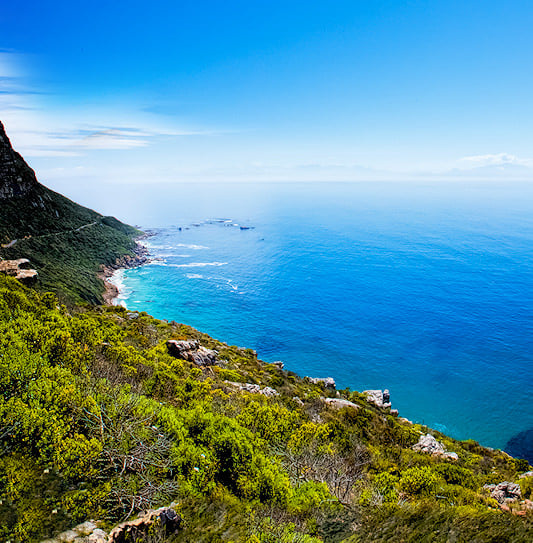
1-Day Cape Point & Cape of Good Hope Tour
Help Me Plan
Down the Peninsula to Africa’s Southwestern Tip
Enjoy a day exploring the Cape Peninsula accompanied by a personal guide. Guests are met at any location of their choice in Cape Town and are returned there upon completion of the day trip.
Tour Overview
Sandstone cliffs, fynbos and two lighthouses mark the far end of the Cape Peninsula, where Table Mountain National Park runs down to the sea. The outward drive follows the Atlantic shore over Chapman’s Peak to Cape Point and the Cape of Good Hope. On the way home the road runs beside False Bay to Boulders Beach and its colony of African penguins.
Travel Pace & Connections
The day makes a loop, out on the Atlantic side and back along False Bay, with pickup and drop-off at your hotel or any other address in Cape Town. Walks are short and mostly level. The exception is the path up to the old lighthouse, and the Flying Dutchman funicular covers most of that climb, leaving a flight of steps to the viewing platform at the top.
Ideal For
First-time visitors to Cape Town see in one day how wild the coast becomes beyond the city. Eland, bontebok and ostriches graze the reserve’s fynbos, and chacma baboons live there too, which is why food is best kept out of sight. Photographers get high cliffs, open ocean and penguins on the beach in a single outing.

 Tour Ref. Code
 Starting Date
 Starting Point
 Ending Point
 Customizable
 Type
 Accommodation Level
 Countries Visited
 Attractions Visited
- Stunning Coastal Views
- Cape Point
- Penguins at Boulders Beach

Detailed Itinerary: 1-Day Cape Point & Cape of Good Hope Tour


Day 1: Itinerary

Highlights
- Chapman’s Peak Drive showcasing dramatic Atlantic coastal scenery
- Cape Point lighthouse area with panoramic Cape Peninsula views
- African penguin colony viewing at sheltered Boulders Beach
Guests are met at any location of their choice in Cape Town to begin the Cape Point and Cape of Good Hope Nature Reserve Day Tour. The journey follows the spectacular Chapman’s Peak Drive, a renowned coastal toll road carved into steep cliffs above the Atlantic Ocean, before continuing through Noordhoek toward the Cape of Good Hope section of Table Mountain National Park. This protected area is rich in biodiversity and home to antelope species, birdlife, and the unique fynbos vegetation of the Cape Peninsula. A highlight of the visit is time at Cape Point, where guests can walk or take the funicular toward the historic lighthouse area for sweeping ocean views.
Chapman’s Peak Drive covers 9 km between Hout Bay and Noordhoek and takes 114 curves to do it, cut into the cliffs high above the Atlantic. Work began in 1915, and Prince Arthur of Connaught opened the road in May 1922. Rockfalls closed it for about three years from 2000, and it reopened as a toll road in December 2003. It still closes when the weather turns or the rock is unstable. On those days the route crosses the mountains on Ou Kaapse Weg instead, through the Silvermine section of the park.
Cape Point has two lighthouses. The first was lit in 1860 on the peak, 238 m above the sea, but low cloud could hide it for up to 900 hours a year. After the Portuguese liner Lusitania struck Bellows Rock in 1911, a new light was built lower down on Dias Point, at 87 m. The new light was finished in 1919 and remains the most powerful lighthouse on the South African coast. About 2.3 km to the west, a wooden sign marks the Cape of Good Hope as the most southwesterly point of Africa. Bartolomeu Dias sailed round it in 1488. The southernmost tip of the continent is Cape Agulhas, some 150 km to the east-southeast.
The Cape Peninsula has long been an important maritime landmark and remains one of South Africa’s most scenic regions. On the return journey, the tour includes a visit to Boulders Beach near Simon’s Town, a sheltered cove within Table Mountain National Park famous for its colony of land-based African penguins. Boardwalks allow close viewing while protecting the environment.
The colony at Boulders began with just two breeding pairs in 1982 and has grown to about 2,500 birds, with 790 breeding pairs counted in the June 2026 census. African penguins are now listed as critically endangered, and the boardwalks at Foxy Beach bring you within a few meters of them while keeping the nesting areas undisturbed. Expect to hear them as well as see them: their braying call earned the species its old name of jackass penguin.
After enjoying the coastal scenery and wildlife, the tour continues back to Cape Town for drop-off at the original pickup location.
Included

- Services of a registered African Sky guide
- Private transportation in an air-conditioned vehicle
- A light lunch for the value of R150
- Tourism Levy
- All Applicable Taxes
- All activities and entrance fees to places mentioned in the itinerary
- Park and Entrance fees, if applicable
Excluded

- Personal and Medical Insurance
- Activities not specifically stated in the itinerary
- Drinks
- Gratuities
1-Day Cape Point & Cape of Good Hope Tour

Other Itineraries You Might Like
Cape Town has plenty more for a second or third day out.

1-Day Table Mountain & Kirstenbosch Gardens Tour
Stay closer to the city for the cableway up Table Mountain and an afternoon among the proteas at Kirstenbosch.

1-Day Robben Island & Cape Town History Tour
A day of Cape Town history, from Mandela’s cell on Robben Island to the 17th-century Castle of Good Hope.

1-Day Private Franschhoek Wine Route Tour
Franschhoek’s Huguenot valley and its wine estates make an easy second day trip from the city.

3-Day Quick Cape Town Tour
A three-day Cape Town stay that fits the peninsula in alongside the cableway, the Waterfront and a tasting at Spier.