


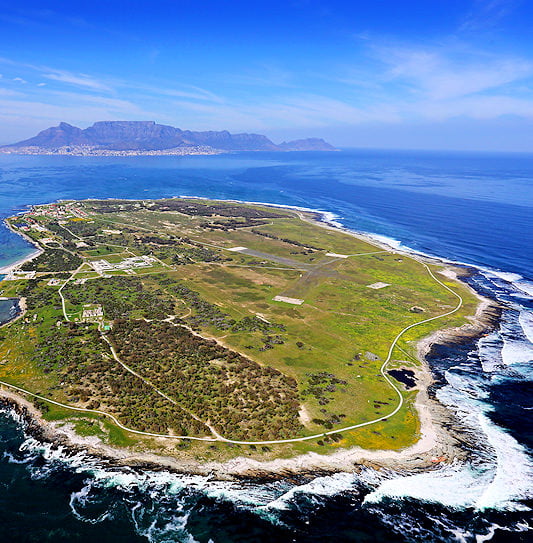
1-Day Robben Island & Cape Town History Tour
Help Me Plan
Robben Island and Cape Town’s Colonial Past
Guests will explore some of Cape Town's historic highlights before visiting the notorious prison on Robben Island, infamous for being the home of many political prisoners during the Apartheid era, most notably Nelson Mandela.
Tour Overview
Nelson Mandela spent 18 of his 27 years in prison on Robben Island, about 6.9 km off Bloubergstrand in Table Bay. UNESCO inscribed the island as a World Heritage Site in 1999. The morning is given to the official museum tour, reached by ferry from the V&A Waterfront. After lunch, the afternoon turns to the city’s Dutch beginnings at the Castle of Good Hope and the Company’s Garden.
Travel Pace & Connections
The island tour lasts about three and a half hours, including the ferry crossings, and boats leave on a fixed timetable from the Nelson Mandela Gateway at the Clock Tower. Rough seas sometimes cancel sailings, and a free day later in your stay leaves room to rebook, or to fit in one of our other Cape Town tours. The afternoon stops are a few minutes’ drive apart in the city center, and the walking there is level.
Ideal For
Readers of Long Walk to Freedom already know the lime quarry and the prison from its pages, and walking through them shows how modern South Africa came about. The afternoon adds a compact picture of the city’s older history, from the first Dutch garden to the stone castle that replaced the original fort.

 Tour Ref. Code
 Starting Date
 Starting Point
 Ending Point
 Customizable
 Type
 Accommodation Level
 Countries Visited
 Attractions Visited
- Cape Town
- Robben Island

Detailed Itinerary: 1-Day Robben Island & Cape Town History Tour


Day 1: Itinerary

Highlights
- Ferry to Robben Island and guided maximum-security prison visit
- See Nelson Mandela’s cell and learn island’s UNESCO history
- Explore Castle of Good Hope and stroll Company’s Garden
The tour begins with a visit to the Robben Island Gateway at the V&A Waterfront (Nelson Mandela Gateway), where a ferry is boarded to the island. Robben Island is a powerful symbol of the struggle against apartheid and a UNESCO World Heritage Site, and the visit includes a guided experience through the maximum-security prison. A highlight is viewing Nelson Mandela’s former cell, alongside broader interpretation of daily prison life and the island’s layered history. Depending on conditions and schedules, the outing typically includes time on the ferry and an island tour element before returning to the V&A Waterfront, where guests can enjoy lunch before continuing with Cape Town’s historic attractions.
The crossing takes about 30 minutes, with Table Mountain behind you as the city falls away. On the island, a bus tour stops at the lime quarry where political prisoners labored. It also passes the kramat, a Muslim shrine, the old leper graveyard and a church designed by Sir Herbert Baker, before ending at the former maximum-security prison. Part of the tour is led by a former political prisoner, who describes daily life in the cell blocks from his own experience.
The name comes from the Dutch word for seals, which were once plentiful in these waters. Long before apartheid, the Dutch and then the British used the island as a penal colony, and a leper colony operated here from 1846 to 1931. The last political prisoners left in 1991, and the prison opened as a museum in 1997.
First on the afternoon agenda is the Castle of Good Hope, historically significant as South Africa’s oldest existing building, constructed between 1666 and 1679. After visiting the Castle, the tour continues to the Company’s Garden, established in 1652 by the Dutch East India Company as a produce garden supporting passing ships and the early settlement. Today it is a central public park and botanical space where guests can stroll among key features such as the gardens and ponds while your guide adds context to Cape Town’s colonial-era development.
The Castle is a pentagon with a bastion at each of its five corners. It replaced an earlier fort of earth and sods near the beach and was declared a national monument in 1936. The Company’s Garden covers 3.2 ha along Government Avenue, with Parliament beside it and the Iziko South African Museum and National Gallery within its grounds. A pear tree planted around 1652 still grows here, the oldest cultivated pear tree in the country. St George’s Cathedral and the Slave Lodge stand near the main entrance, on the corner of Adderley and Wale streets.
After the final stop, guests are transferred back to their chosen drop-off locations in Cape Town.
Included

- Services of a registered African Sky guide
- Private transportation in an air-conditioned vehicle
- A light lunch for the value of R150
- Tourism Levy
- All Applicable Taxes
- All activities and entrance fees to places mentioned in the itinerary
- Park and Entrance fees, if applicable
Excluded

- Personal and Medical Insurance
- Activities not specifically stated in the itinerary
- Drinks
- Gratuities
1-Day Robben Island & Cape Town History Tour

Other Itineraries You Might Like
The island is one side of Cape Town; these show the mountain, the peninsula and the vineyards.

1-Day Table Mountain & Kirstenbosch Gardens Tour
From the ferry you look back at Table Mountain, and this day takes you up it by cableway and on to Kirstenbosch.

1-Day Cape Point & Cape of Good Hope Tour
Leave the city for Chapman’s Peak Drive, the Cape Point lighthouses and the penguins at Boulders Beach.

1-Day Stellenbosch Wine Route Tour
The Dutch colonial story carries on inland at Stellenbosch, founded in 1679, with two wine tastings to end the day.

5-Day Cape Town Explorer Tour
Robben Island, Table Mountain, Cape Point and the Winelands, spread over five days with four nights in the city.