


Reasons to Visit Namibia
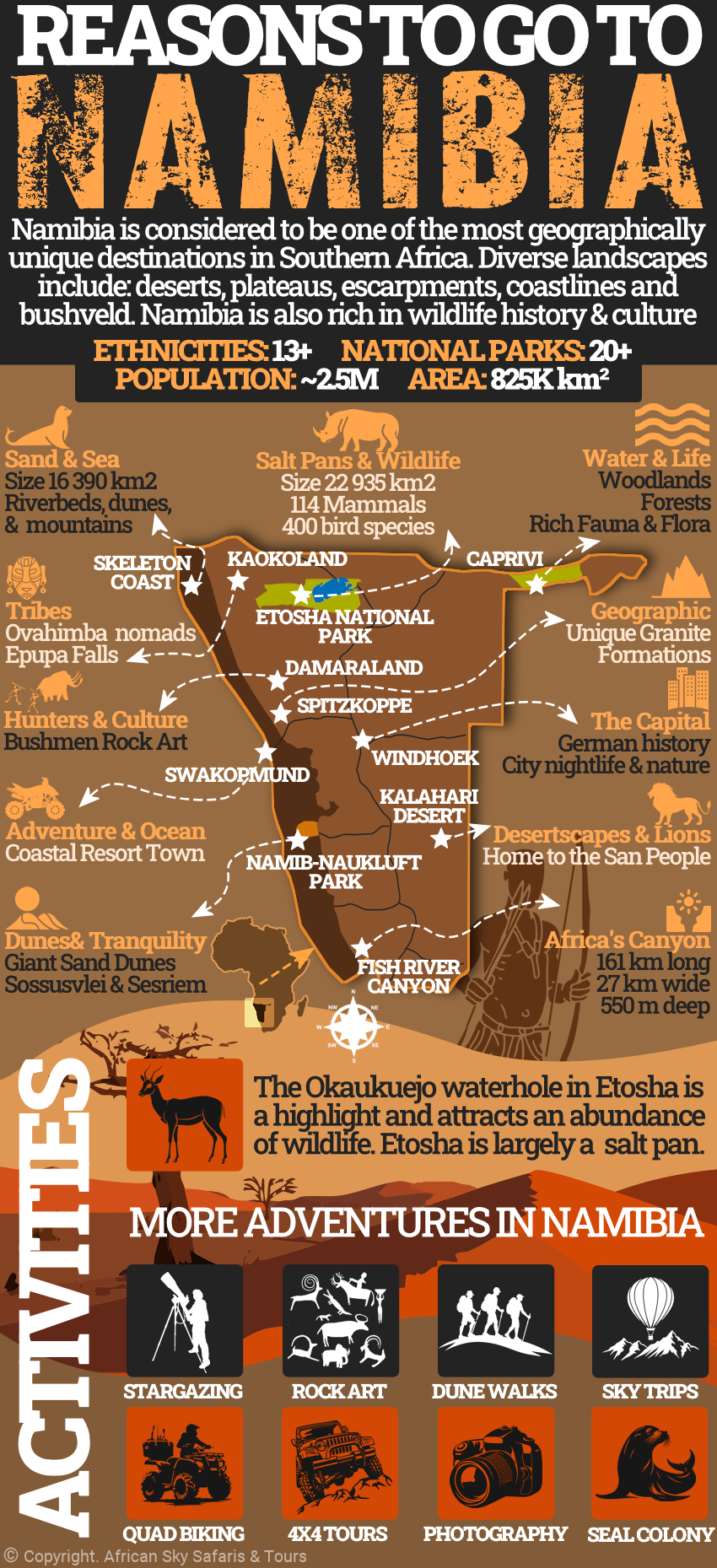
Namibia is emerging as a popular safari destination in Southern Africa. This infographic summarizes the country's areas and provides compelling reasons for visiting.
Share this on Social Media


Popular Activities
Some of Namibia's most popular safari activities include game viewing in famous national parks, desert experiences, such as hot air balloon flights, desert nature drives and hikes, and some of the most impressive stargazing opportunities in the world. There are coastal towns for those who wish to admire the harsh Atlantic coastline, abundant marine life, and endless landscapes without a soul in sight, a spiritual experience in many respects. Whichever of these adventures appeals to your likes will be an enriching experience.
Impressive Destinations
The most alluring destination in Namibia is Etosha National Park, with its incredible wildlife concentrations and the opportunity to view and photograph rare black rhinos, often after dark at the floodlit waterholes of the rest camps. The vast expanse of the Namib Desert can be experienced at Sossusvlei, or on the Skeleton Coast from remote camps or the comfort of a luxury property in the coastal town of Swakopmund with its distinct German character.
Interesting Facts
After Mongolia, Namibia is the most sparsely populated country on earth. It is home to 13 different ethnic groups, has over 20 national parks, and is rich in geographical diversity, with deserts, plateaus, mountain ranges, an endless coastline, and some of the world's highest dunes. Wildlife still roams free in large parts of the country, and an opportunity exists to view rare desert-adapted animals in their natural habitat.
The map's figures put Etosha National Park at 22,935 km², with 114 mammal species and more than 400 bird species, figures that match those of the Namibian Ministry of Environment, Forestry and Tourism. Etosha is largely a salt pan, and the infographic singles out the Okaukuejo waterhole as a highlight that draws an abundance of wildlife.
On the coast, the Skeleton Coast park covers 16,390 km² of riverbeds, dunes and mountains. Farther south, Namib-Naukluft Park takes in the giant dunes of Sossusvlei and Sesriem, and the map marks the Fish River Canyon in the far south, labeled Africa's Canyon.
Above the map, the introduction describes Namibia as one of the most geographically unique destinations in Southern Africa, with deserts, plateaus, escarpments, coastlines and bushveld. Between the parks, the map also marks Kaokoland, Damaraland, Spitzkoppe, Windhoek, Swakopmund, the Kalahari Desert and Caprivi. The activities panel at the bottom rounds things off with stargazing, rock art, dune walks, hot air balloon trips, quad biking, 4x4 tours, photography and visits to a seal colony.
Sources
- Namibia Tourism Board: Visit Namibia
- Ministry of Environment, Forestry and Tourism: Skeleton Coast Park
- Ministry of Environment, Forestry and Tourism: Etosha National Park
Disclaimer
The information included in infographics on the www.africansky.com website serves as general knowledge when traveling to Southern Africa.